Leadership Styles · Journal 009
The fluidity
of power
A practical framework for understanding influence, sharing authority and knowing when clinical leaders need to step forward.
Healthcare is too complex for leadership to rest with one person at the top of a hierarchy. Modern clinical services bring together many professions, organisations and perspectives. No single leader can hold all the knowledge needed to make every decision well.
This does not mean that leadership becomes less important. It means that leadership must become more flexible.
A fluid leader knows when to share power, when to create space for others and when to step forward with clarity. Their role is not to be the hero of the system, but to help the whole system work.
From command to constellation
Traditional leadership often assumes that authority flows downwards: leaders decide, managers translate and frontline teams deliver. That model can create order, but it can also slow decisions, silence expertise and leave staff waiting for permission to act.
Storey and Holti offer a different image: a leadership constellation. Leadership is distributed across a group rather than concentrated in one individual. Different people take the lead at different moments, depending on their expertise and their closeness to the problem.
In clinical practice, this matters. The person with the most senior title may not be the person who best understands a patient’s immediate needs, a failing process or the pressures affecting a team.
Technical competence remains essential, but it is not enough. Good healthcare leadership must also create the conditions in which people can contribute fully.
| A command-led approach | A fluid approach |
|---|---|
| Authority sits mainly at the top. | Leadership moves to where the expertise is. |
| Compliance is closely monitored. | People understand and own the purpose. |
| Problems move upwards for decisions. | Teams are supported to solve problems early. |
| Leaders focus on oversight. | Leaders create safety, clarity and connection. |
| Staff deliver the plan. | Staff help shape and improve the plan. |
The aim is not to remove accountability. It is to place responsibility closer to the work while keeping clear standards for quality, safety and equity.
Understanding how power works
Leadership is an exercise in influence. French and Raven described five common sources of power:
- Expert power: influence grounded in knowledge and experience.
- Referent power: influence built through trust, respect and identification.
- Legitimate power: authority that comes with a recognised role or responsibility.
- Reward power: the ability to offer recognition, opportunity or benefit.
- Coercive power: the ability to impose a penalty or negative consequence.
These sources of power can be understood as a spectrum. At one end, influence depends on trust, expertise and shared ownership. At the other, it depends more heavily on monitoring, incentives and sanctions.
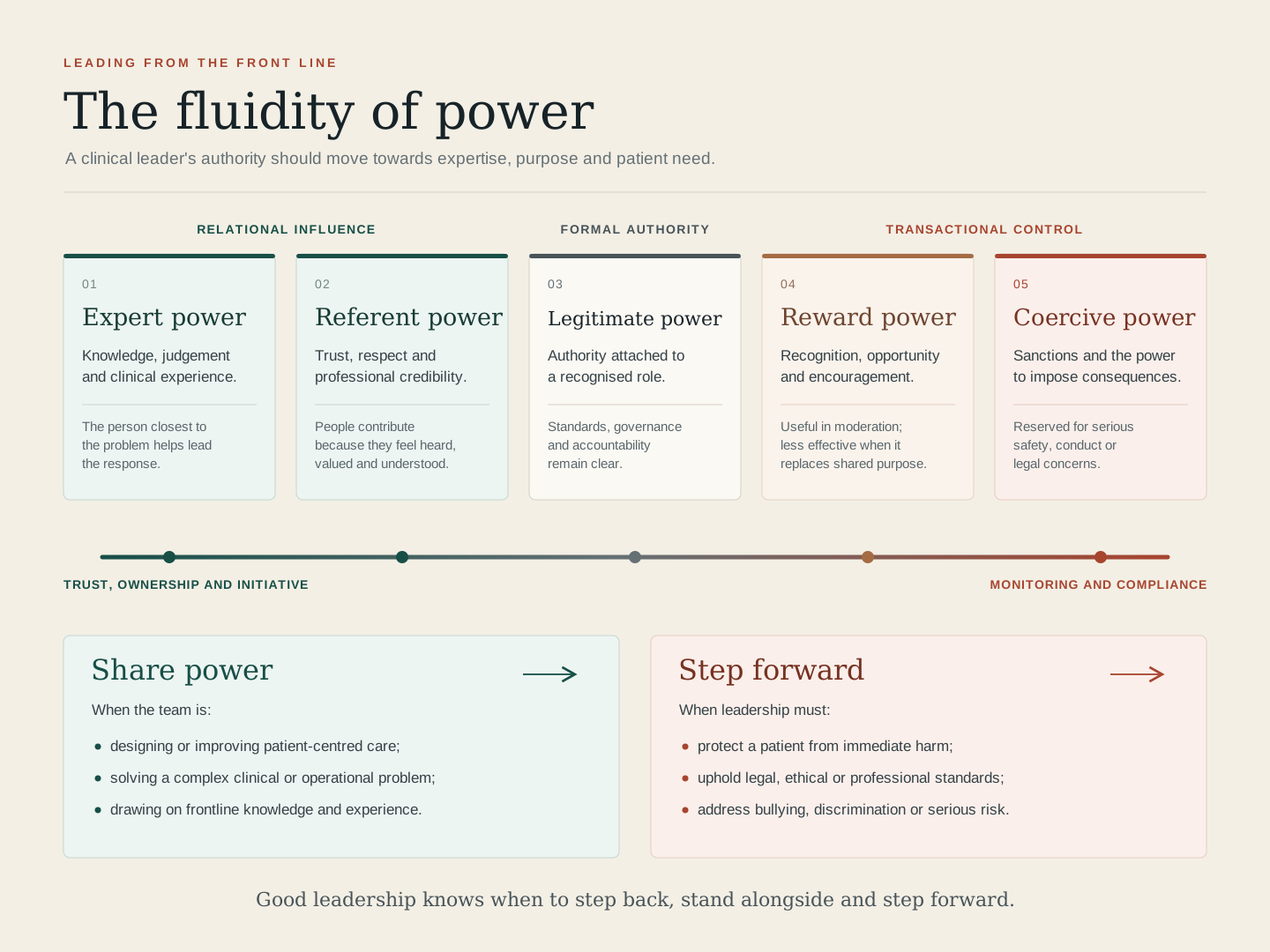
Reward and coercive power can produce quick compliance, but the effect is often fragile. People may follow instructions while they are being observed, yet return to old behaviours when scrutiny is removed. Coercion can also create resistance because people feel that change is being done to them.
Legitimate, referent and expert power are more likely to create lasting change when they are used well. People act because they trust the leader, value the purpose or believe the decision is sound. The behaviour becomes internally owned rather than externally enforced.
Safe care depends on what people do when nobody senior is watching.
The emotional climate matters
Leadership affects more than tasks and structures. It shapes how work feels.
Affective Events Theory suggests that everyday workplace events create emotional responses, which then influence behaviour and performance. Research by McColl-Kennedy and Anderson linked transformational leadership with two particularly important emotions: optimism and frustration.
Their study was conducted in a pharmaceutical company rather than the NHS, so its findings should be applied with care. Even so, the practical message is useful: removing frustration may matter as much as inspiring optimism.
Leaders sometimes try to improve morale through encouragement while leaving the causes of frustration untouched. A positive message cannot compensate for unclear processes, duplicated work, poor communication or a lack of resources.
The fluid leader therefore asks:
- What is making good work unnecessarily difficult?
- Which barriers can I remove?
- What decisions can be made closer to the patient?
- Where does the team need clarity, support or protection?
If repeated problems are left unresolved, staff can begin to believe that nothing they do will make a difference. Seligman described this as learned helplessness. Skilled people may still care deeply, but lose confidence in their ability to change the system around them.
Leadership should interrupt that cycle. It should help teams see that problems can be named, understood and acted upon.
Psychological safety and equity
Clinical leaders also shape who feels able to speak, challenge and contribute.
Psychological safety means that people can raise concerns, acknowledge uncertainty and discuss mistakes without fear of humiliation or unfair punishment. It is not the absence of accountability. It is the foundation for honest learning and safer care.
Equity is central to this. David Williams’ work describes racism and discrimination as public health exposures that create ongoing vigilance, uncertainty and stress. In the workplace, discrimination can also make people less likely to speak openly, particularly when previous concerns have been dismissed or have led to negative consequences.
A psychologically safe and equitable team should make it possible to:
- Raise clinical concerns without fear of blame.
- Question how opportunities and resources are distributed.
- Report discrimination without fear of retaliation.
- Challenge a senior view when patient care may be at risk.
The test of an inclusive culture is not whether leaders say that challenge is welcome. It is what happens to the person who challenges them.
When to share power and when to step forward
Fluid leadership is not passive leadership. Nor does distributing authority mean avoiding difficult decisions.
The fluid leader moves between two positions.
Share power
Power should move towards frontline expertise when teams are:
- Designing patient-centred services.
- Solving complex clinical or operational problems.
- Improving routine practice.
- Responding to local knowledge that senior leaders may not possess.
Here, the leader’s task is to listen, connect people, remove barriers and create room for good judgement.
Step forward
The leader should be visible and decisive when:
- Patient safety is at immediate risk.
- Legal, ethical or professional standards must be protected.
- A crisis requires coordination and clear priorities.
- Inequality, bullying or discrimination is being ignored.
Here, the leader’s task is to set direction, take responsibility and protect the conditions in which others can work safely.
This balance requires what Tamkin and colleagues call self-confident humility: enough confidence to act, and enough humility to know when someone else should lead.
A practical test for clinical leaders
When facing a difficult situation, five questions can help:
- Who is closest to the problem?
- Whose expertise or experience is missing?
- Am I seeking genuine ownership or simple compliance?
- What frustration or risk can I remove?
- Does this moment require me to step back, stand alongside or step forward?
The fluidity of power is not about giving up control. It is about using authority with greater judgement.
Healthcare inequality, poor performance and staff disengagement are not simply individual failings. They are often signs that the system is distributing voice, opportunity and risk badly. The clinical leader’s role is to help correct that distribution.
The leadership test
The strongest leader enables others to act, keeps the purpose clear and knows when their own intervention is truly needed.